
What thismonthcovers.
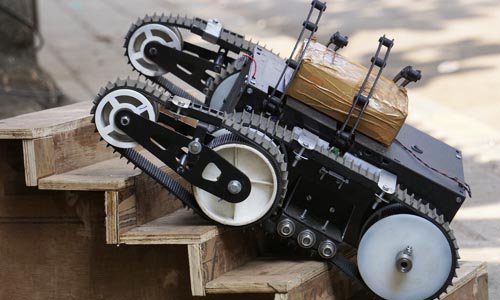
The capstone is where the pathway pays off. Working in small teams, students scope a real problem, then design, build, program, test, and demonstrate a complete electromechanical device, presenting it publicly at the end of the month.
1 month (~20 sessions) — the final module of the journey
DURATION
Team build studio, daily stand-ups, weekend integration sessions, ~15 students / 3–4 teams
FORMAT
CAD and electronics courses; AI-assisted programming strongly recommended
PREREQUISITES
One integrated working device, a test report, and a public demo-day presentation
DELIVERABLE
Continuous build reviews, an integration test, and a judged demo day with outside guests
ASSESSMENT
A bill-of-materials budget per team, full workshop access, and mentor time
PROVIDED
By month'send, astudent can…
- CLO1Turn a vague real-world problem into an engineering specification with measurable requirements and constraints.
- CLO2Design a device that integrates a mechanical assembly, a power and control circuit, and embedded software into one system.
- CLO3Plan and manage the build: bill of materials, schedule, task split, and risk list, updated as things change.
- CLO4Integrate and commission subsystems, and debug failures that cross the mechanical / electrical / software boundary.
- CLO5Test against the original specification, record results honestly, and state what does and does not work.
- CLO6Present the device and its evidence to a non-specialist audience on demo day.
Advancingthe wholepathway.
A graduate of E47’s three-month engineering pathway can do all six of the outcomes below. This one-month module carries the highlighted ones.
Where thiscoursesits.
Every E47 value lands in the capstone at once: a tangible output (Educate), aimed at a local problem and built to be repairable locally (Elevate), opening a path to a venture through the Sandbox incubator (Empower), and judged by outside guests on demo day (Excel).
It is the last course because it needs every earlier one — it is the assembly point for CAD, electronics, competition-grade discipline, and AI-assisted coding. A student who finishes the capstone has done, in miniature, the whole job of an engineer.
The strongest capstones feed E47's Sandbox incubator from Year 2 — where a graduate turns the device into a real product.
Each course is one month. A student’s journey with E47 is 3 months — three one-month modules that hand off to each other and finish on the mechatronic capstone.
Tools thestudentwill use.
Full CAD + slicer + 3D-printing workflow
Microcontrollers, drivers, sensors, power electronics
Embedded C/C++ with AI-assisted coding
Workshop hand & power tools + bench instruments
BOM, schedule, risk list, test log
One student,onemonth.
Planning estimate in USD for Cohort 1 in Hunza, covering this one-month module for a single student on the free track.
| Instructor + TA + technical-mentor time (per-student share) | $40 |
| Project bill of materials (motors, drivers, chassis, sensors, battery, hardware) | $45 |
| 3D printing, machining & build iterations | $22 |
| Software (education CAD + embedded toolchain) | $9 |
| Workshop & bench-equipment depreciation (per-student share) | $16 |
| Space, power, internet | $18 |
| Assessment & public demo day | $10 |
| Total — per student, 1 month | $160 |
About $160 of a roughly $350 blended three-month cost per student — the capstone is the most materials-heavy module, and the intended finish to the journey.